
Table of Contents
- What Emergency Restoration Services for Offices Actually Cover
- The Commercial Water Damage Restoration Process, Step by Step
- Emergency Business Continuity Planning Before the Next Call
- What Drives the Cost of Emergency Office Restoration
- Insurance Claims Documentation: What Adjusters Need From You
- How to Choose an Emergency Response Partner
- Frequently Asked Questions
Last Updated: September 13, 2026
What Emergency Restoration Services for Offices Actually Cover
When a pipe bursts above a server room at 2 a.m., the damage clock starts immediately. Emergency restoration services for offices are the professional mitigation and recovery services that stabilize a commercial property after water, fire, mold, storm, or biohazard damage, then return it to a safe, usable condition. At Advance Restoration Remediation, we’ve handled these calls for nearly 20 years across Maryland, DC, and Virginia, and the scope is almost always broader than the property manager expects.
The work splits into four core service lines. Each one has its own equipment, timeline, and documentation requirements.
Water Extraction and Structural Drying
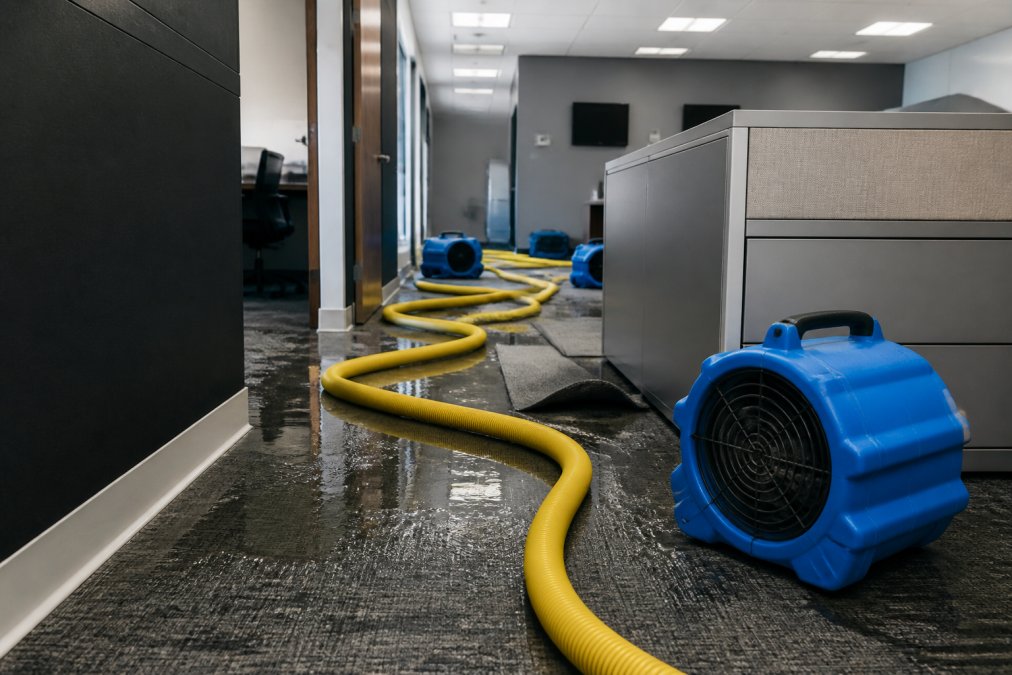
Water damage is the most common commercial loss. The response follows a defined sequence: emergency dispatch, moisture mapping to find hidden saturation, water extraction, then structural drying with industrial air movers and dehumidification equipment. The goal is to dry the building envelope, not just the visible carpet.
Timing matters more than anything else here. Mold can begin colonizing wet materials within 24 to 48 hours, which is why a genuine 24/7 emergency response matters (the EPA). A crew that arrives in four hours prevents far more damage than one that arrives the next morning.
Fire, Smoke, and Soot Remediation
Fire restoration is not just about the burned area. Smoke travels through HVAC systems and deposits soot on surfaces far from the flames. Proper smoke remediation involves board-up services to secure the site, soot removal from walls and ceilings, HVAC cleaning, and sanitization to remove odor at the source.
FEMA guidance on commercial property disaster recovery
The Commercial Water Damage Restoration Process, Step by Step
The commercial water damage restoration process follows a documented sequence from emergency call to final walkthrough. Skipping or rushing any step is the most common reason restoration fails and mold returns months later.
Most jobs move through these phases, and each one has a defined purpose and a measurable exit condition:
- Emergency dispatch and site stabilization. The crew secures the site, shuts off the water source if it is still active, and isolates the affected zone. For an office, that often means cordoning off a suite, rerouting foot traffic, and protecting unaffected tenant spaces from cross-contamination.
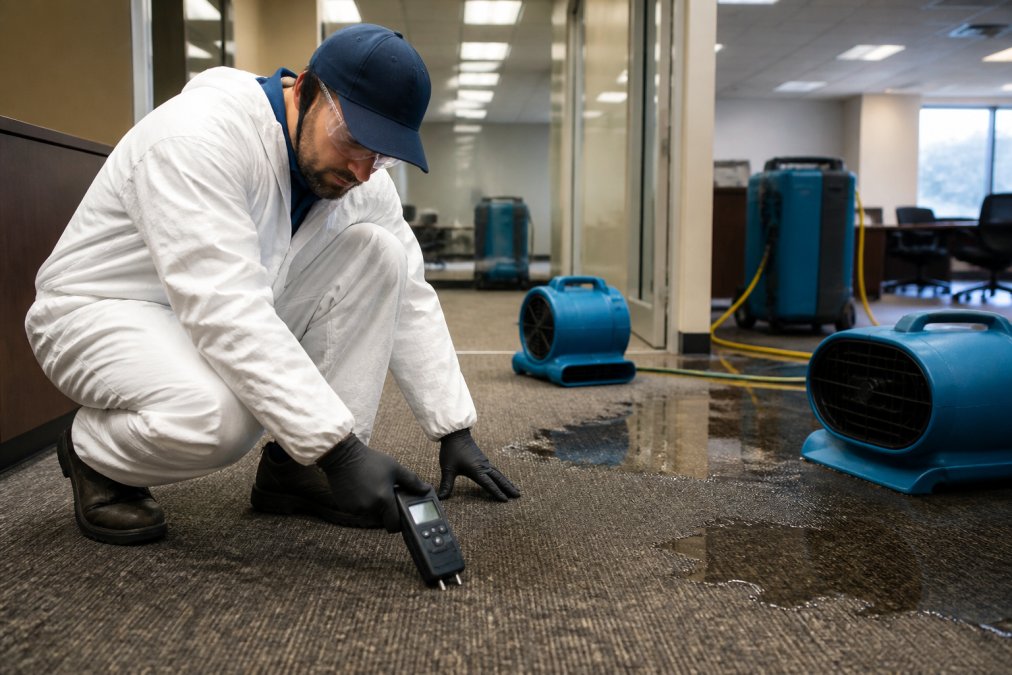
- Property assessment and moisture mapping. Technicians use thermal imaging cameras and penetrating and non-penetrating moisture meters to map saturation across drywall, baseboards, carpet, ceiling tiles, and subfloor. The map becomes the baseline for the drying plan and the insurance file.
- Water extraction. Truck-mounted or portable extractors remove standing water and the bulk of water held in carpet and padding. Extraction comes before drying because air movers cannot dry a floor that is still under water.
- Structural drying and dehumidification. Industrial air movers create airflow across wet surfaces while refrigerant or desiccant dehumidifiers pull moisture out of the air so it does not re-settle into materials. Technicians typically monitor temperature, relative humidity, and material moisture content daily and adjust equipment placement until readings return to a dry standard for the material type.
- Sanitization and decontamination. After drying, affected surfaces are cleaned and treated. Category 2 (gray water) and Category 3 (black water) losses, common with sewage backups or flooding, require antimicrobial treatment and, in some cases, removal of porous materials that cannot be saved.
- Reconstruction and final air quality testing. Drywall, ceiling tiles, flooring, and paint are restored, then a final moisture and air quality check confirms the space is ready for occupancy.
A common mistake is declaring the job finished when surfaces feel dry. Moisture hides inside wall cavities and subflooring, and only moisture mapping and air quality testing confirm the building is actually dry. Drying equipment typically runs for three to five days on a moderate commercial loss, but a saturated subfloor or a building with poor ventilation can push that longer. Ask for daily moisture readings in writing, they are the objective record that the drying was done correctly.
If a restoration crew skips moisture mapping or final air quality testing, mold can return within weeks. That is the single most common reason property managers end up paying for the same damage twice.
Ask your provider for the daily moisture log at the final walkthrough. It is the single best piece of evidence that the building was dried to standard, and it is the document your adjuster will want to see.
Emergency Business Continuity Planning Before the Next Call
Emergency business continuity planning is the process of preparing your office to survive a disaster with minimal downtime before that disaster happens. Most offices have no written plan, which is why a single burst pipe can close a business for weeks.
A practical plan covers four things:
- A current emergency contact list, including your restoration partner
- Documented shutoff locations for water, gas, and electrical
- A pre-approved restoration vendor so no time is lost negotiating
- A communication protocol for staff and clients
The businesses that recover fastest are the ones that made these decisions before the emergency. Signing a pre-approved agreement with a restoration provider removes the scramble when every hour of downtime costs money.
What Drives the Cost of Emergency Office Restoration
The cost of emergency office restoration depends on the size of the affected area, the category of water or damage, how long the damage sat before mitigation began, and whether reconstruction is needed. There is no flat rate, and any provider quoting a firm number over the phone without seeing the site is guessing.
Most commercial restoration estimates are built from a handful of variables. Understanding them lets you sanity-check a quote instead of accepting it on faith:
- Affected square footage. Extraction, drying, and cleaning are priced by area. A single flooded conference room is a different job than a flooded floor plate.
- Water category. Category 1 (clean supply line) is the cheapest to remediate. Category 2 (gray water from appliances or toilet overflow) and Category 3 (black water from sewage or outdoor flooding) require more labor, antimicrobial treatment, and often disposal of porous materials.
- Material types. Carpet and pad are usually removed and replaced. Hardwood, engineered flooring, and certain ceiling tiles may be salvageable with specialty drying but cost more to dry in place than to tear out.
- Time before mitigation. This is the biggest lever. Damage that sits for days spreads into walls, ceilings, and flooring, turning a contained extraction job into a full reconstruction project. Fast response is the cheapest form of restoration.
- Reconstruction scope. Mitigation (extraction, drying, cleaning) and reconstruction (drywall, paint, flooring, ceiling) are separate line items. A quote that lumps them together hides where the money goes.
- After-hours and access constraints. Night and weekend dispatch, freight elevator scheduling, and building security escorts can add labor hours to a job.
Pricing also varies by service line. Water extraction and drying, mold remediation, fire and smoke cleanup, and biohazard decontamination each carry different labor and equipment costs. Ask any provider to break the estimate down by service so you can see where the money goes.
A few practical habits keep costs predictable. Get the estimate itemized by service line and by room or zone. Ask whether the drying equipment charge is per day or flat, because a job that runs long can quietly inflate the bill. Confirm in writing whether the estimate includes reconstruction or stops at mitigation. And ask what triggers a change order, a hidden mold find or a failed moisture reading is a legitimate reason for one, but you should know the threshold before work starts.
Get the estimate in writing and itemized by service line before work begins. A provider who won’t itemize is a provider you can’t hold accountable.
Time is the cost multiplier. Every day between the loss and the start of mitigation adds scope, materials, and labor, which is why a pre-approved restoration vendor is a financial decision, not just a convenience one.
Insurance Claims Documentation: What Adjusters Need From You
Insurance claims documentation is the evidence package that supports your claim, and incomplete documentation is the leading cause of denied or reduced payouts. Adjusters need proof of the damage, proof of the cause, and proof of the cost.
Gather these items:
- Date-stamped photos and video of all damage before cleanup
- A written damage assessment from a licensed restoration professional
- Moisture mapping and air quality testing records
- Itemized invoices for mitigation and reconstruction
- Any police, fire, or utility reports related to the loss
A restoration partner experienced with insurance claims will document the site the way an adjuster expects, which speeds approval and reduces disputes. Insurance Information Institute guidance on filing property claims
How to Choose an Emergency Response Partner
Choosing an emergency response partner comes down to four checks: licensing and insurance, response time, scope of services, and documentation practices. Get all four in writing before you need them.
- Licensed, bonded, and insured. If a crew damages your property, you need their insurance to cover it, not yours.
- True 24/7 availability. Ask what happens when you call at 3 a.m. on a holiday.
- Full-service capability. A partner who handles water, fire, mold, biohazard, and reconstruction means one point of contact instead of five.
- Documentation discipline. Detailed records make your insurance claim smoother.
Advance Restoration Remediation is licensed, bonded, and insured, family owned and operated, and has served commercial and residential clients for nearly 20 years. Property managers and rehabbers trust us for recurring projects because we show up on time and handle the insurance paperwork.
Frequently Asked Questions
How quickly should a restoration company respond to an office emergency?
For water damage, mold can begin growing within 24 to 48 hours, so the response window matters. A reliable emergency restoration provider should have a live dispatcher and a stated on-site arrival target, often within a few hours for commercial properties. Ask upfront what their after-hours process looks like and whether they can dispatch industrial drying equipment the same day, since delays raise both the cost of emergency office restoration and the risk of business interruption.
What services are included in emergency office restoration?
A full emergency restoration scope typically covers water extraction, structural drying, dehumidification, moisture mapping, smoke remediation, mold mitigation, biohazard cleanup, board-up services, HVAC cleaning, and post-restoration air quality testing. Many providers also handle reconstruction so you are not left coordinating a separate contractor. Ask for a written scope before work starts, and confirm whether sanitization and decontamination are included or billed separately.
Does business insurance cover emergency restoration services?
Most commercial property policies cover sudden and accidental damage from water, fire, or storms, and often include business interruption coverage that reimburses lost income during closure. Coverage depends on your specific policy, deductible, and cause of loss. Document everything from the first hour: photos, moisture readings, damaged inventory lists, and receipts. A restoration partner experienced with insurance claims can format this documentation the way adjusters expect, which speeds up approval.
What is the difference between restoration and remediation in a commercial setting?
Remediation removes the hazard, such as mold, contaminated water, or soot, and stops it from spreading. Restoration returns the space to its pre-loss condition, including drywall, flooring, paint, and fixtures. In practice, most office emergencies need both: remediation first to stabilize the site, then restoration to make it usable again. Confirm in writing which phases your provider handles in-house, because gaps between the two are where projects stall and costs climb.
A single unplanned disaster can halt your operations for weeks, and the difference between a fast recovery and a long shutdown is who you call. Advance Restoration Remediation provides 24/7 emergency response, hassle-free insurance claims support, and full reconstruction so your office gets back to work with minimal disturbance. Get started with Advance Restoration Remediation and get your estimate today.
