
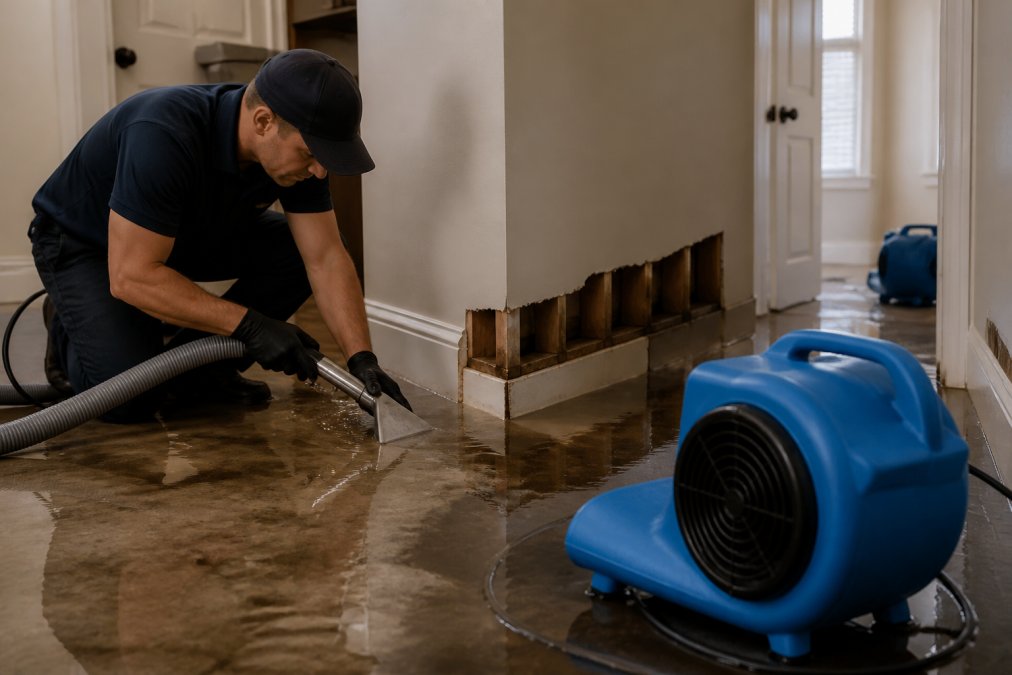
Table of Contents
- What Counts as an Emergency: Water Damage Categories and Response Times
- The First 60 Minutes: Steps Before Help Arrives
- Emergency Water Extraction Services: What the Equipment Actually Does
- Water Damage Insurance Claim Process: Documenting Before You Dry
- How to Choose a Water Damage Company in Maryland
- DIY vs. Professional Thresholds: When You Can Handle It Yourself
- Mold, Sewage, and Hidden Damage: What Maryland Homeowners Miss
- Frequently Asked Questions
Last Updated: September 16, 2026
What Counts as an Emergency: Water Damage Categories and Response Times
Emergency water damage cleanup in Maryland starts with one question: how contaminated is the water? That answer determines your response time, safety gear, and whether your insurance claim survives scrutiny. This guide from Advance Restoration Remediation covers the first hour, the claim process, and when to call a professional.
Category 1, 2, and 3 Water: Why the Label Changes Everything
Category 1 water is clean water from a sanitary source, such as a supply line or leaking faucet. It poses no immediate health risk but degrades to Category 2 within 24 to 48 hours if left standing.
| Category | Source Example | Health Risk | Typical Response |
|---|---|---|---|
| Category 1 | Supply line, faucet leak | Low | Extract and dry within 48 hours |
| Category 2 | Washer overflow, toilet bowl | Moderate | Extract, sanitize, dry |
| Category 3 | Sewage backup, flood water | High | Full PPE, remove porous materials, disinfect |
The First 60 Minutes: Steps Before Help Arrives
What you do before a crew arrives determines how much of your home survives. Homeowners who shut off the source and start documentation lose far less than those who wait.
- Shut off the water source or call the utility if you cannot find the valve
- Cut power to affected rooms at the breaker panel, but only if you can reach it dry
- Photograph everything before you move it, including standing water depth
- Move furniture and valuables off wet carpet
- Do not enter rooms with sagging ceilings or standing water near outlets
Never wade into standing water in a basement without confirming the power is off. Electrocution is a real risk in flooded basements, and it is the leading cause of preventable injury during water damage cleanup.
Emergency Water Extraction Services: What the Equipment Actually Does
Emergency water extraction services use truck-mounted vacuum systems to pull standing water out of carpet, pad, and subfloor faster than any consumer wet-dry vac. Speed matters because mold spores can colonize a wet surface within a day.
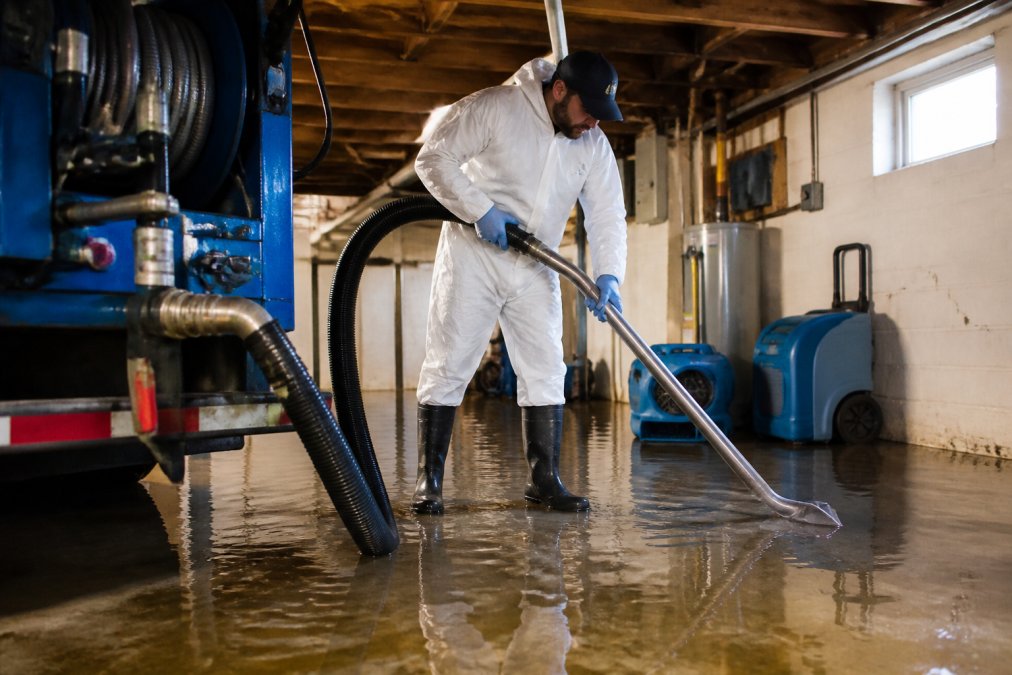
A professional crew typically brings:
- Truck-mounted extraction units that remove hundreds of gallons per hour
- Thermal imaging cameras to find hidden moisture behind walls
- Hygrometers to measure moisture content in framing and drywall
- Air scrubbers and industrial fans for the drying phase
Water Damage Insurance Claim Process: Documenting Before You Dry
The water damage insurance claim process rewards homeowners who document before they clean. Adjusters work from evidence, and evidence disappears the moment you haul wet drywall to the curb.
The Claim File Checklist
Build your file in this order, before any restoration work begins:
- Date and time log. Note when you discovered the water, shut off the source, and called your insurer. Adjusters use this to establish the loss window.
- Wide, then close photos. Start with a wide shot of each affected room showing standing water depth against a tape measure or common object, then close-ups of the water source, damaged belongings, and any staining or warping.
- A narrated walkthrough video. Film a slow pass through every affected area before moving anything. State the date, the room, and what you see. This timestamped evidence is hard to dispute.
- Moisture readings. Ask your restoration provider for hygrometer and thermal imaging readings before and after drying. These readings are the proof of scope that separates a documented claim from a guess.
- Receipts. Keep every receipt for emergency purchases, hotel stays, meals during displacement, and any equipment you rented.
- A written timeline. One page, chronological, plain language. Include who you called and when.
What Adjusters Actually Look For
Adjusters evaluate three things: proof the damage was sudden and accidental, proof of the cause, and proof of the scope. A burst pipe claim with dated photos, a plumber’s note, and before-and-after moisture readings moves faster than a vague description and a single phone photo.
Sudden vs. Gradual: The Coverage Line That Decides Your Claim
Most homeowners policies cover sudden and accidental discharge, such as a burst supply line, failed water heater, or appliance hose that let go. Most exclude gradual damage, such as a slow leak under a sink that stained the cabinet over months. The distinction is not how much water there was, but how long it was there.
Working With Your Adjuster Without Slowing the Claim
Keep these points in mind:
- Notify your insurer promptly, even if you are not sure the loss is covered.
- Do not sign anything from a contractor that assigns your claim benefits without reading it carefully.
- Ask your restoration provider to bill your carrier directly if they offer it, and get the scope of work in writing.
- Keep a single point of contact at the insurance company and log every call with a date and a name.
Film a slow walkthrough video before you touch anything. Narrate what you see, including the water source and the depth of standing water. Adjusters accept this as timestamped evidence, and it takes two minutes.
Do not throw away damaged materials until your adjuster has seen them or your restoration provider has documented them with photos and moisture readings. Once the wet drywall is at the curb, the scope evidence is gone.
How to Choose a Water Damage Company in Maryland
The right provider shows up fast, documents thoroughly, and handles your insurance paperwork. But ‘fast and friendly’ is not a credential. Here is how to separate a qualified restoration company from a call center that subcontracts your job.
Verify These Before You Sign
- Licensing and insurance. Ask for a certificate of insurance showing general liability and workers’ compensation coverage. A legitimate company provides this without hesitation.
- IICRC certification. The IICRC S500 Standard for Water Damage Restoration is the industry benchmark for water damage work. Ask whether the technicians on site hold current IICRC certifications in water damage restoration and applied structural drying.
- Written response time. Get the arrival window in writing. A verbal ‘we’ll be there soon’ is not a commitment.
- Direct insurance billing. Ask whether the company works directly with adjusters and can bill your carrier. This reduces the back-and-forth that delays claims.
- Before-and-after moisture readings. A qualified provider documents moisture content with a hygrometer and thermal imaging before and after drying. Without readings, they cannot prove the structure is dry.
- A written scope of work. You should receive a documented plan listing what will be extracted, what will be removed, what equipment will be used, and how long drying is expected to take.
Regional Flood Risk: Why Location Changes the Job
Water damage in this region is not one problem. It is several, and the right provider should know the difference.
Red Flags
- No physical address or verifiable local presence
- Pressure to sign an authorization of benefits before you have read it
- No written estimate or scope of work
- No moisture readings offered before or after drying
- A quote that is dramatically lower than every other bid, with no explanation of what is excluded
What a Qualified Provider Brings
Advance Restoration Remediation has served Maryland, DC, and Virginia for nearly 20 years as a family owned and operated business. The team is licensed, bonded, and insured, offers 24/7 service, and handles insurance claims directly.
Response time is the single best predictor of final repair cost. A crew that arrives within hours can often save carpet, pad, and drywall. A crew that arrives in three days usually cannot. But speed without documentation and certification just moves the problem faster.
If a company cannot show you moisture readings, a written scope of work, and proof of insurance, do not let them start work. An undocumented job is a claim you may not be able to prove.
DIY vs. Professional Thresholds: When You Can Handle It Yourself
Most homeowners can handle a small, clean-water spill on a hard surface. Everything else belongs to a professional.
| Situation | DIY or Professional | Why |
|---|---|---|
| Small Category 1 spill on tile | DIY | Dry within 24 hours with fans |
| Category 1 water on carpet and pad | Professional | Pad must be removed and subfloor dried |
| Any Category 2 water | Professional | Sanitization required |
| Any Category 3 water or sewage backup | Professional | Health hazard, requires PPE and disposal |
| Basement flooding over 1 inch | Professional | Extraction equipment and moisture mapping needed |
Mold, Sewage, and Hidden Damage: What Maryland Homeowners Miss
Mold growth is the most common hidden consequence of water damage cleanup done halfway. Porous materials that look dry on the surface can stay damp inside for weeks.
If a musty smell returns weeks after drying, the moisture source was never fully addressed. Reopening the same area costs more than doing the moisture mapping correctly the first time.
Frequently Asked Questions
Does homeowners insurance cover water damage restoration?
Most standard homeowners policies cover sudden, accidental water damage, like a burst pipe or appliance failure. Flood damage from outside the home typically requires separate flood insurance through the National Flood Insurance Program. Keep receipts, photograph everything before cleanup starts, and report the loss promptly. Your adjuster will confirm what your specific policy covers, so review your declarations page before you assume anything is excluded.
How quickly should water damage be cleaned up to prevent mold?
Mold can begin colonizing wet materials within 24 to 48 hours, so the clock starts the moment water touches drywall, carpet, or subfloor. Emergency water damage cleanup in Maryland should ideally begin the same day. If you cannot get a crew out immediately, remove standing water, run fans and a dehumidifier, and pull up saturated rugs. Document everything before you move it, since your insurance claim depends on that evidence.
How do I verify if a restoration company is licensed and insured?
Ask for the company’s Maryland Home Improvement Commission license number and a certificate of insurance showing general liability and workers’ compensation coverage. Call the insurer directly to confirm the policy is active, not just current on paper. A legitimate water damage company will hand over these documents without hesitation. If a contractor dodges the question or asks for a large cash deposit upfront, walk away and find someone else.
What are the signs of hidden water damage in a home?
Watch for a musty smell that lingers after cleaning, warped or bubbling paint, soft spots in floors, and baseboards that feel spongy. A spike in your water bill with no change in habits can point to a slow leak behind a wall. Moisture meters and thermal imaging cameras detect what your eyes miss, which is why a professional water damage assessment matters even when the visible mess looks minor.
Water damage rarely waits for a convenient moment, and the decisions you make in the first hour shape the final bill. Advance Restoration Remediation responds 24/7 across Maryland, DC, and Virginia with fast extraction, moisture mapping, and direct insurance claim support. The team is licensed, bonded, and insured, family owned and operated, and backed by nearly 20 years of experience. Get started with Advance Restoration Remediation and get your property dry, documented, and restored.
